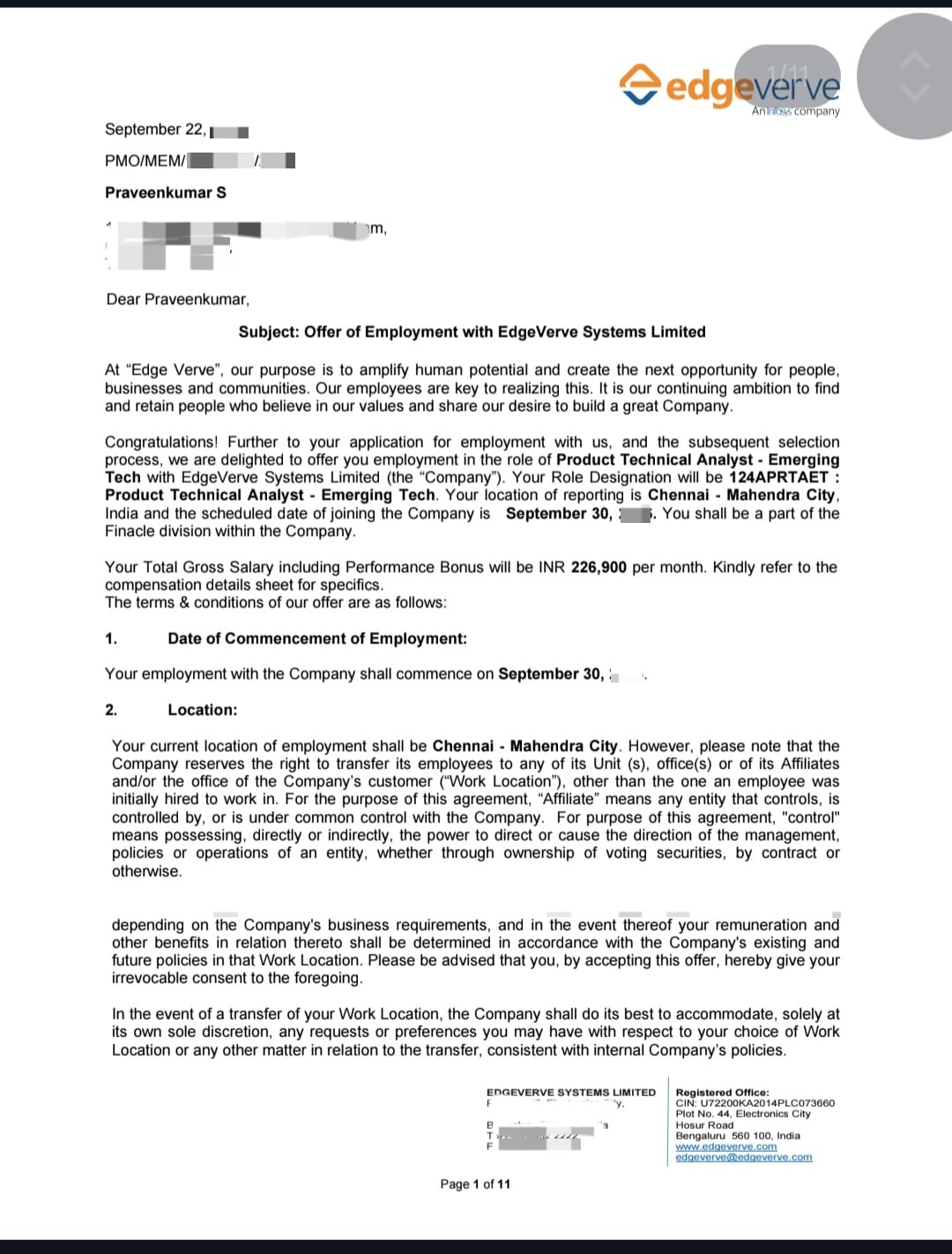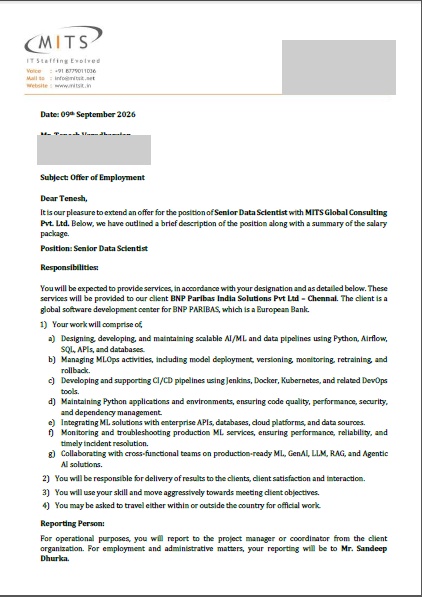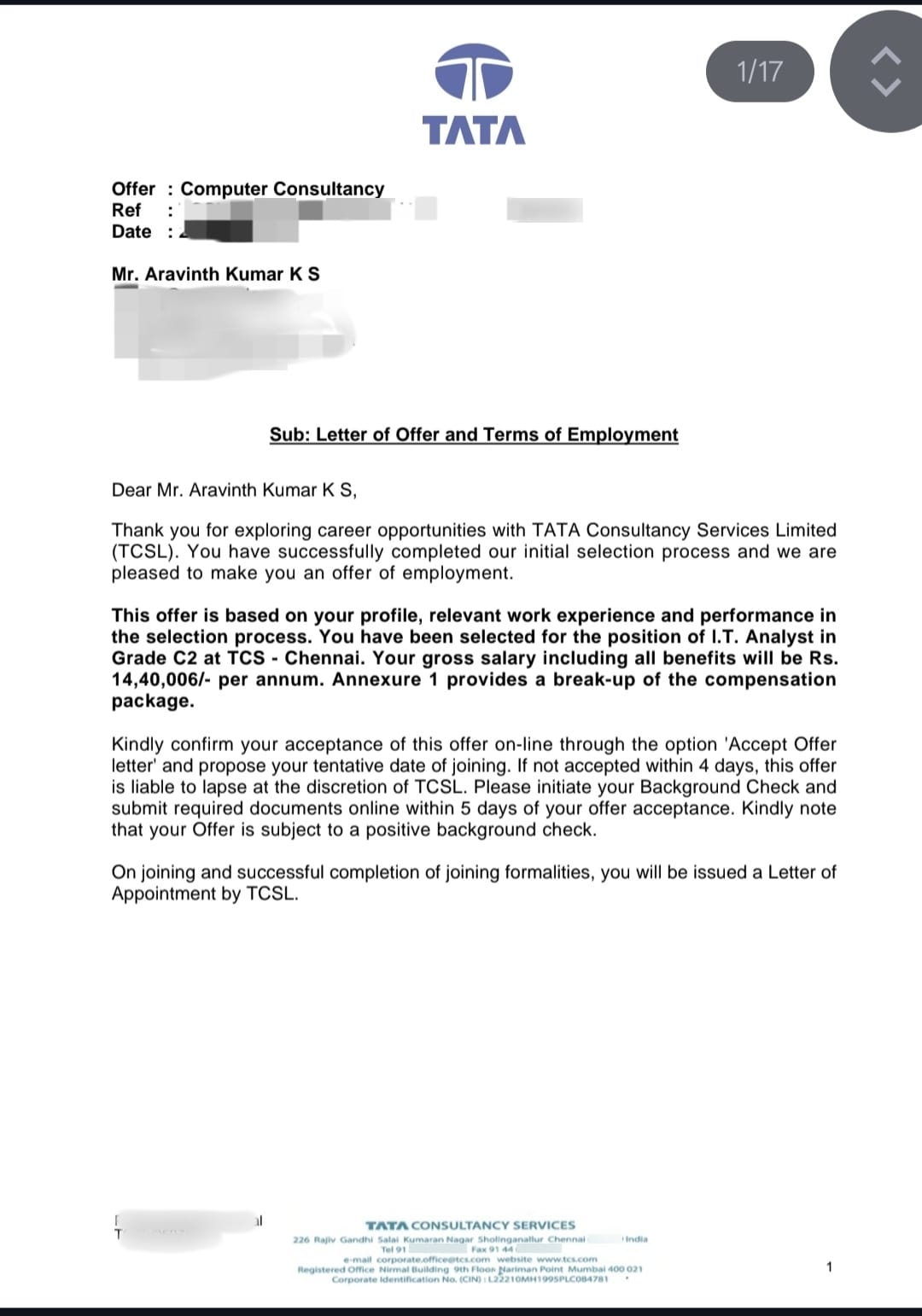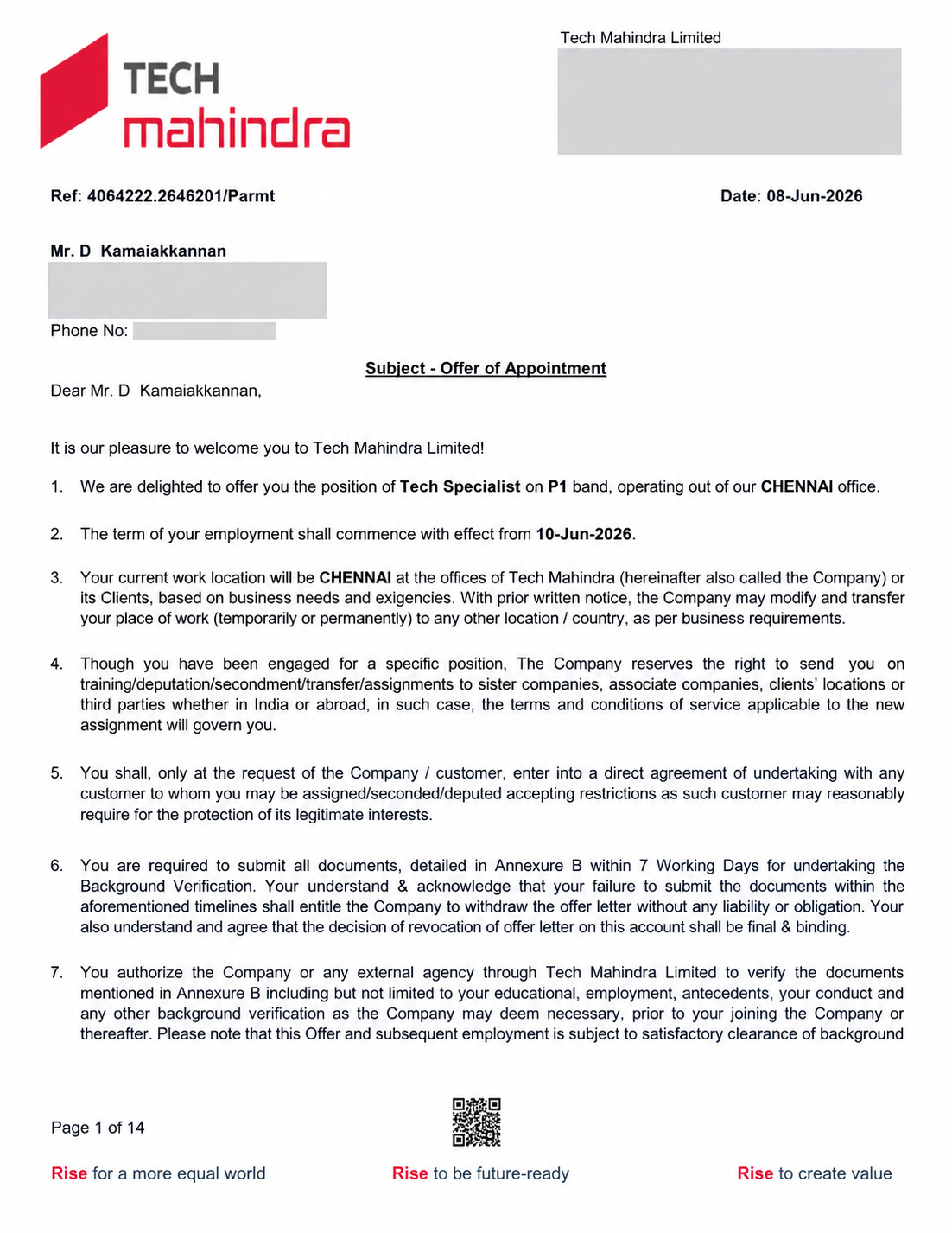
Artificial Intelligence Training in Chennai

Learn AI in Chennai with Certification and Placements.

Master Python, Machine Learning, Deep Learning (CNN, RNN), NLP, Generative AI, Agentic AI and AI on AWS with real-time industrial project implementation. A 7-level, 31-module programme from your first line of Python to production AI, with zero prior AI experience needed.

  • 500+ Hiring Partners
  • Lifetime Placement Support
  • Bilingual Training in Tamil & English
  • Global Certification Preparation
AI processor chip on a circuit board

Build Your Future in Artificial Intelligence

Speak with our training team to explore the skills, certifications and support you need to get started.

  • Real-Time Projects & Hands-On Training
  • Dedicated Mock Interviews & Resume Building
₹70+ LPA
Highest Salary Potential
100%*
Placement Support
1,00,000+
Careers Launched
4
Flexible Training Modes

Why Choose Greens Technologies for AI Training in Chennai?

Greens Technologies provides IT training for students and working professionals seeking to develop practical, job-relevant technical skills.

Practical Learning

Industry-Relevant Curriculum

Experienced IT Trainers

Flexible Training Modes

Personalized Learning Support

Real-World Project Exposure

Placement Support

Flexible Batch Options

Meet Our Founder

A message from the leadership behind Greens Technologies.

Founder & Managing Director

Greens Technologies Leadership

Building Chennai's leading software training & placement institute

"Our mission is simple: make quality software education accessible, practical and 100% job-oriented."

What began as a single training center in Adyar has grown to 25 branches across Chennai, Trichy and Salem, offering training, consultancy and development services, with 1,00,000+ students placed through 500+ hiring partners.

15+ YearsIn IT Industry
1,00,000+Students Placed
25Branches

Meet Our AI Specialists & Practice Leads

Learn under the direct mentorship of Greens Technologies leadership and battle-tested industry practitioners, with direct 1-on-1 practical lab guidance from senior AI specialists.

Want to talk directly to our Trainer before enrolling?

Schedule a 15-minute 1-on-1 technical counselling session to discuss your background, syllabus questions, and custom career transition roadmap.

Placement Success Stories

Hear from our students about their learning experiences, placement journeys and how Greens Technologies helped them prepare for the next step in their careers.

01 / 06
Select a Student Story

Get Industry Recognized Certification

Greens Technologies' AI certification is recognised by 500+ global companies. Our AI & Deep Learning certification showcases your knowledge and skills in Artificial Intelligence, Machine Learning, Neural Networks and real-time project execution, with a certificate at every level of the programme.

Benefits of AI Certification

  • To demonstrate your proficiency and skills in Artificial Intelligence & Deep Learning,
  • To add weightage to your professional resume & LinkedIn profile,
  • To enhance your credibility in designing, building and deploying real-world AI models,
  • To fast-track interview shortlisting across top AI & MNC hiring partners.
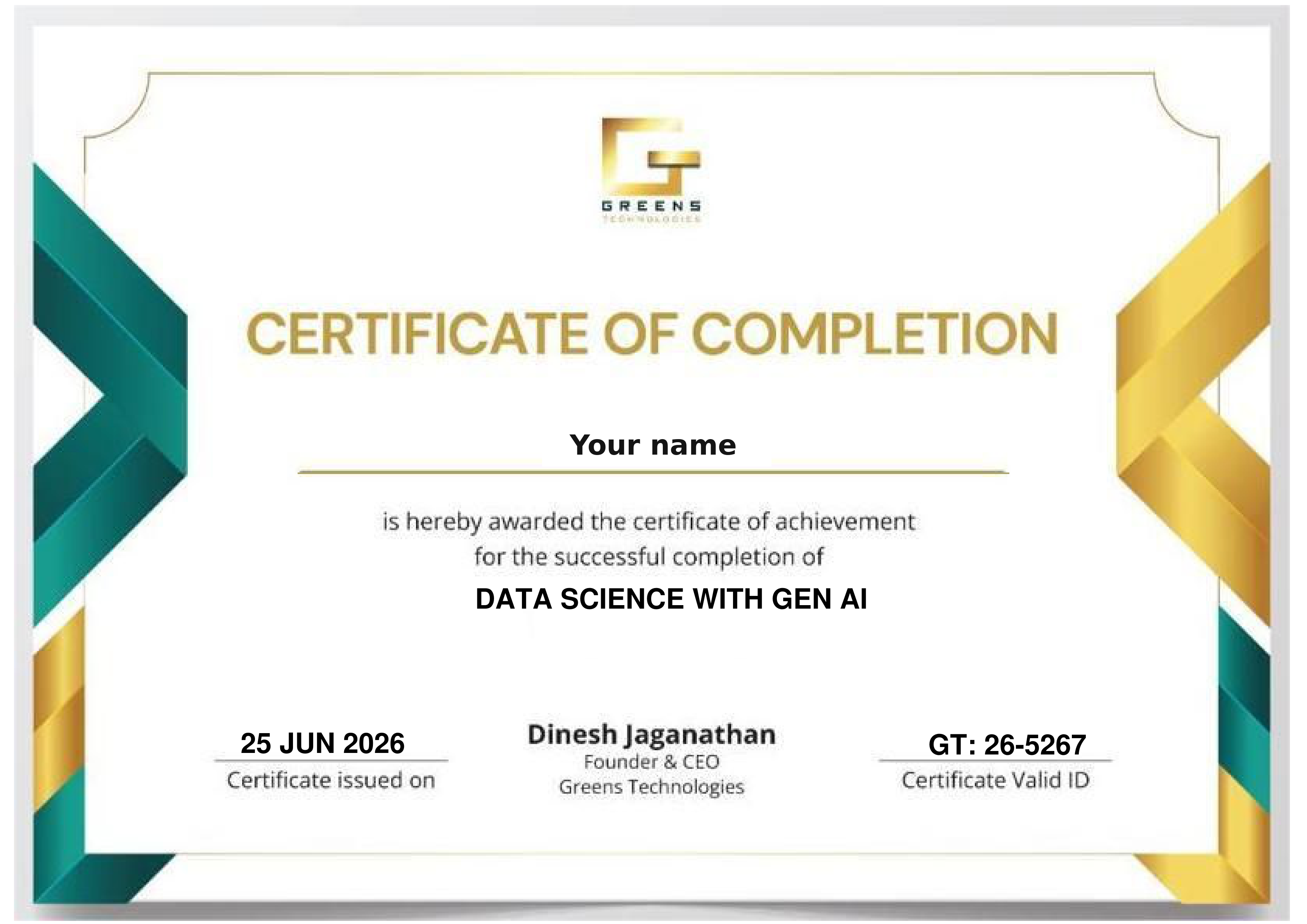
Sample Greens Technologies certificate of completion

Global Certification Pathways

Click a certification to see how the course prepares you. Provider exams are optional and their fees are paid separately to the provider.

Validates core AI, ML and generative AI concepts on AWS. Level 7 (AI for Cloud & DevOps) covers AWS Bedrock, SageMaker and serverless AI on AWS. Exam fee: USD 100.

For building AI applications and agents. Levels 5 and 6 cover LLMs, RAG, tool design and multi-agent systems. Exam fee varies by region.

Validates LLM and generative AI fundamentals. Level 5 covers LLM internals, prompt engineering, fine-tuning and evaluation. Exam fee: USD 125.

For building RAG and LLM applications on Databricks. Builds on the Level 3 Databricks and Level 5 RAG modules. Exam fee: USD 200.

Course Curriculum 2026 - From First Line of Python to Production AI

The Complete AI Programme: a seven-level career ladder spanning 31 in-depth industrial modules (~47 weeks / ~11 months). Join at the level that fits you or climb the entire ladder, with a certificate at each stage and hands-on portfolio projects.

Programming from zero to AI-ready · No prerequisites — taught from scratch

Python 3AnacondaJupyterVS CodeNumPyPandasMatplotlibrequestsPydanticFastAPIasyncio
  • Overview of Python and its real-world AI applications
  • Environment setup: Anaconda & Jupyter Notebook
  • Syntax, variables, comments, and conventions
  • Data types: integers, floats, strings, type casting
  • Introduction to standard functions (print, input)
  • Operators and their types (arithmetic, logical, bitwise)
  • Collections: Lists, tuples, sets, and dictionaries
  • Indexing, slicing, and collection operations
  • Conditional statements (if, elif, else)
  • Loops: for, while, break, and continue statements
  • Nested loops and functions; parameters & return values
  • Built-in functions, local scope vs global scope
  • filter, map, reduce, zip; lambda expressions
  • Recursive, generator, and decorator functions
  • Exception handling: try, except, finally, raise
  • Handling exceptions by error type and custom exceptions
  • File Handling: open(), with ... as statement
  • Regular expressions with re module
  • Standard utility modules: os, csv, sys, time, datetime, calendar
  • OOPs Concepts: Class and object; polymorphism; inheritance
  • Encapsulation; data abstraction; magic/dunder methods
  • NumPy: Arrays and their fundamental advantage over lists
  • NumPy Operations: Creating, indexing, slicing, reshaping, flattening
  • Pandas: DataFrames and Series; creating from lists & dictionaries
  • Data Ingestion: Reading and writing CSV, Excel, and JSON formats
  • Data Manipulation: Selecting, filtering, sorting, and ranking
  • Data Cleaning: Missing data imputation, transformation, categorical encoding
  • Aggregations: GroupBy, aggregation methods, and apply()
  • Matplotlib: Line, bar, scatter, and histogram plots
  • Visualization Styling: Titles, labels, legends, styles, saving plots
  • Environment & Project: venv, uv, pip, requirements.txt
  • .env files and keeping API keys out of source code
  • Modern project layout and clean architecture for an AI service
  • Type hints and the typing module for robust Python
  • requests and REST fundamentals — headers, auth, status codes
  • JSON in depth: parsing, nested structures, serialisation
  • API Error handling, retries, and exponential backoff algorithms
  • Rate limits, throttling, and pagination strategies
  • Pydantic models, field validation, schema generation
  • JSON Schema and why modern AI tool calling depends on it
  • Parsing and validating untrusted model output safely
  • async / await and asyncio core fundamentals
  • Concurrent API calls with asyncio.gather
  • Generators and streaming token responses
  • FastAPI: building your first AI microservice, routes, request & response models

SQL, Statistics & Power BI · Unlocks: Data Analyst, MIS & Reporting Analyst

MySQLMySQL WorkbenchPower BI DesktopPower QueryDAXStar Schema Modelling
  • Data, Database, DBMS, and RDBMS; SQL vs NoSQL paradigms
  • MySQL installation & setup; Database, Table, Row, Column concepts
  • SELECT, WHERE; comparison & logical operators
  • NULL handling (IS NULL / IS NOT NULL)
  • BETWEEN, IN, LIKE, pattern matching, wildcards
  • ORDER BY, DISTINCT, LIMIT, OFFSET, column aliases
  • COUNT, SUM, AVG, MIN, MAX aggregate functions
  • GROUP BY, HAVING; WHERE vs HAVING mechanics
  • Table relationships; INNER, LEFT, RIGHT, FULL JOIN
  • Multi-table joins and complex queries
  • Primary key, foreign key, table constraints
  • Normalization (1NF, 2NF, 3NF); integrity constraints
  • INSERT, UPDATE, DELETE; DELETE vs TRUNCATE vs DROP
  • Subqueries (nested, in SELECT, in WHERE)
  • Views, stored procedures, and user-defined functions
  • Power BI Desktop interface (Report, Data, Model views); importing datasets
  • Charts, filters, slicers; fact vs dimension tables; star vs snowflake schema
  • Introduction to DAX; calculated columns vs measures
  • BI project lifecycle (requirement gathering, development, UAT)
  • Connecting Power BI to MySQL; Power Query data transformation & cleaning
  • Date table with fiscal calendar logic; validating business benchmarks
  • Enterprise Finance Model: Key finance KPIs, fiscal year logic, stable star schema
  • Pre/post invoice discount logic; net sales, COGS, gross margin
  • Full P&L statement, dynamic measure switching
  • YoY & YoY% trend analysis across business cycles
  • Sales & Marketing Analytics: Customer, region, and market performance; discount leakage
  • Supply Chain Analytics: Forecast vs actual sales, inventory & delivery KPIs
  • Descriptive Statistics: Central tendency (mean, median, mode), dispersion, 5-number summary
  • Probability Distributions: Bernoulli, Poisson, Uniform, Normal/Gaussian
  • Central Limit Theorem (CLT) intuition and proofs
  • Inferential Statistics: Hypothesis testing, p-value, significance levels
  • Statistical Tests: Z-test, T-test, Type 1 & Type 2 errors, confidence intervals
  • Non-parametric & Categorical Tests: Chi-square test of independence, ANOVA (Analysis of Variance)

The Analytical Engineer Path · Unlocks: Analytical Engineer, Data Engineer

GitGitHubPySparkAWS EC2S3IAMVPCLambdaGlueAthenaRedshiftDatabricks
  • Version control basics — git init, status, add, commit
  • Branching workflows, merging, merge conflicts, pull requests on GitHub
  • Advanced Git: Rebase vs merge, stash, tags, .gitignore, Git hooks for CI
  • Apache Spark distributed architecture, execution model, cluster manager
  • RDD fundamentals vs high-performance DataFrame API
  • Distributed joins, repartition, coalesce, GroupBy, and window functions
  • Reading and writing AWS S3 data; AWS Glue Catalog integration
  • Compute & Storage: EC2 (Linux/Windows, SSH/RDP), S3 (versioning, lifecycle, storage classes, replication)
  • Identity & Networking: IAM (users, groups, roles, policies), VPC (subnets, gateways, security groups, route tables)
  • Messaging, Serverless & Databases: SNS, SQS, CloudWatch, Lambda, EventBridge, RDS (MySQL/PostgreSQL), DynamoDB NoSQL
  • Pipeline overview, OLAP vs OLTP systems, Data Lake vs Warehouse vs Lakehouse
  • ETL vs ELT architectures, Medallion Architecture (Bronze/Silver/Gold layers)
  • Columnar storage formats: Parquet vs CSV/JSON performance benchmarks
  • Dimensional modelling, star/snowflake schema, fact & dimension table designs
  • Ingest raw source data via serverless AWS Lambda into S3 Bronze layer
  • Transform large-scale datasets using PySpark in AWS Glue/Databricks to Silver/Gold layers
  • Performance tuning with explain(), Catalyst optimizer, predicate pushdown
  • Step Functions orchestration, Athena serverless querying, Redshift warehouse loading, Power BI live publishing

Machine Learning, NLP, Deep Learning & Computer Vision · Unlocks: Data Scientist, ML Engineer

Scikit-learnXGBoostNLTKWord2VecTensorFlowKerasOpenCVDlibNumPyPandas
  • Foundations & EDA: Missing values, imbalanced data, outliers, encoding, feature engineering
  • Regression Models: Linear, Ridge, Lasso, ElasticNet, R², Logistic Regression
  • Hyperparameter tuning: GridSearchCV, RandomizedSearchCV, validation curves
  • Classification & Ensembles: SVM, KNN, Decision Trees, Bagging, Random Forest
  • Advanced Boosting: Gradient Boosting, AdaBoost, XGBoost for tabular competitions
  • Unsupervised Learning: Principal Component Analysis (PCA), K-Means clustering, end-to-end ML project
  • Text Preprocessing: Tokenization, stemming, lemmatization, stopwords, POS tagging, Named Entity Recognition (NER)
  • Vectorization: Bag of Words, N-grams, TF-IDF calculation and weighting
  • Word Embeddings: Word2Vec architectures (Continuous Bag of Words - CBOW, Skip-gram)
  • Module Project: Spam / Ham Classifier — a working text classifier trained end-to-end
  • Neural Network Foundations: Perceptron, Artificial Neural Networks (ANN), Backpropagation, Vanishing Gradient
  • Activation functions: Sigmoid, Tanh, ReLU, LeakyReLU, Softmax
  • Modern optimizers: SGD, Momentum, RMSprop, Adam
  • Convolutional Neural Networks (CNN): Convolutions, Kernels, Pooling, Fully Connected layers
  • Recurrent Neural Networks (RNN): Hidden state dynamics, LSTM gates, Gated Recurrent Units (GRU)
  • OpenCV environment setup, image transformations, video stream manipulation
  • Haar Cascade classifiers for real-time face and eye detection
  • Dlib 68-point facial landmark detection algorithms
  • Eye/Mouth Aspect Ratio (EAR/MAR) mathematical modeling
  • Project: Real-time driver drowsy-state detection and audible alert warning system

LLMs, RAG & Vector Databases · Unlocks: AI Engineer, GenAI Developer, RAG Engineer

OpenAIClaudeGeminiHugging FaceOllamaFAISSChromapgvectorPineconeWeaviateRAGASLangChain
  • 1. What are LLMs? Historical timeline, foundation models, paradigm shifts
  • 2. Generative AI: The Big Picture — VAEs, GANs, Diffusion models, Transformers
  • 3. Tokenization Deep Dive — Byte-Pair Encoding (BPE), WordPiece, SentencePiece
  • 4. Embeddings & Token Representations — high-dimensional semantic spaces
  • 5. LLM Architecture Internals — Decoder-only, RMSNorm, SwiGLU activation, KV cache
  • 6. Positional Encodings — RoPE (Rotary Position Embeddings), ALiBi, Sinusoidal, context extension
  • 7. Mixture of Experts (MoE) — sparse activation, expert routing, load balancing
  • 8. Context Window & Attention Patterns — GQA (Grouped-Query Attention), MLA, Flash Attention, long-context
  • 9. Pre-training Objectives — next-token prediction, Masked LM, causal vs bidirectional
  • 10. Logits, Softmax & Temperature scaling mechanics
  • 11. Sampling Strategies — greedy, top-k, top-p (nucleus), min-p, beam search
  • 12. Multi-turn Conversations & Stateful Memory management
  • 13. Context Engineering — budgeting token window, tools injection, compaction, cache order
  • 14. Prompt Engineering — zero-shot, few-shot, Chain-of-Thought (CoT)
  • 15. Advanced Prompting — Tree-of-Thought (ToT), Self-Consistency, HyDE (Hypothetical Document Embeddings)
  • 16. Prompt Optimization — Automatic Prompt Engineer (APE), prompt chaining, ReAct
  • 17. In-Context Learning dynamics, demonstration selection, and calibration
  • 18. Fine-tuning Strategies — LoRA, QLoRA, DoRA, Parameter-Efficient Fine-Tuning (PEFT)
  • 19. Instruction Tuning & RLHF — Supervised Fine-Tuning (SFT), Reward Models, PPO, DPO, Alignment
  • 20. Hallucinations & Limitations — detection, grounding, and mitigation strategies
  • 21. LLM Security & Safety — prompt injection, jailbreaking, guardrails implementation
  • 22. Evaluation & Benchmarks — perplexity, LLM-as-a-judge, domain-specific evaluation suites
  • 23. Inference Optimization — KV cache optimization, quantization (AWQ, GPTQ, GGUF), speculative decoding, vLLM serving
  • 24. Scaling Laws & Emergent Abilities — Chinchilla laws, compute optimal training, power-law scaling
  • 25. Open-Source LLMs & Local Deployment — Llama 3, DeepSeek, Qwen with Ollama
  • 26. Hugging Face: The Open-Source AI Hub — Hub, Transformers, Datasets, PEFT, TRL, Spaces, Inference Endpoints
  • 27. LLM APIs & Practical Usage — universal API pattern, streaming tokens, function calling, cost optimization
  • 28. Retrieval-Augmented Generation (RAG) — chunking strategies, embeddings, vector search, hybrid retrieval
  • 29. Corrective & Self-RAG — CRAG, Self-RAG architectures
  • 30. Knowledge Graphs — triples, RDF vs property graphs, Cypher, grounding LLMs
  • 31. GraphRAG & Knowledge Graphs for complex entity relationship querying
  • 32. Adaptive RAG & Query Routing across heterogeneous datastores
  • 33. Multimodal RAG — indexing and querying text, tables, and images
  • 34. Agents & Tool Use — function calling, ReAct loops, Model Context Protocol (MCP), multi-agent patterns
  • 35. Multi-Modal LLMs — vision encoders, early fusion, agentic visual reasoning

Agents, MCP & LangGraph · Unlocks: Agentic AI Engineer, AI Automation Engineer

LangChainLangGraphCrewAIAutoGenOpenAI Agents SDKMCPA2ATavilyn8nLangSmithLangfuse
  • 1. Introduction to AI Agents — what agents are and why they represent the future of software
  • 2. Agent Lifecycle — the complete 6-phase architecture powering every autonomous AI agent
  • 3. Function Calling — OpenAI and Anthropic tool use APIs
  • 4. Structured Outputs — JSON mode, Pydantic schemas, and reliable parsing
  • 5. Designing Tools — creating effective tools and strict interface boundaries for agents
  • 6. Agent Tool Ecosystem — browser, code execution, API, and database tools
  • 7. Computer-Use Agents — driving a real screen: pixels, grounding, verification, containment
  • 8. ReAct Pattern — reasoning and acting in loops
  • 9. Agent Planning — task decomposition and planning strategies
  • 10. Reasoning Patterns — Chain-of-Thought, Self-Consistency, structured reasoning
  • 11. Tree of Thought — branching exploration, parallel reasoning, backtracking
  • 12. LangChain Fundamentals — building agents with LangChain core & community
  • 13. Agent Frameworks — CrewAI, AutoGen, and framework architectural comparison
  • 14. Vector Databases — Pinecone, Weaviate, ChromaDB for RAG
  • 15. Advanced RAG — chunking strategies, hybrid search, reranking with Cohere
  • 16. Agent Evaluation — testing and evaluating agent performance & task accuracy
  • 17. Model Context Protocol (MCP) — MCP standard for standardized tool and context interfaces
  • 18. Agent Memory Systems — short-term, long-term, and episodic memory
  • 19. LangGraph Agents — stateful multi-step agents, cyclical graphs, checkpointing
  • 20. Multi-Agent Patterns — orchestration, delegation, collaborative teams
  • 21. CrewAI Multi-Agent Systems — role-based crews and collaborative AI teams
  • 22. OpenAI Agents SDK — building production agents with OpenAIs official SDK
  • 23. Agent-to-Agent Protocol — Googles A2A protocol for agent interoperability
  • 24. Agent Guardrails & Safety — input validation, output filtering, safety boundaries
  • 25. Agent Observability — tracing, logging, and debugging agent systems with LangSmith/Langfuse
  • 26. Agentic Workflow Patterns — query routing, parallel execution, chaining, event-driven orchestration
  • 27. Agent Deployment — production deployment patterns and horizontal scaling
  • 28. Durable Agents — surviving crashes, deploys, and human-in-the-loop pauses
  • 29. Full-Stack GenAI Application — production architecture: React + FastAPI + LangGraph + HITL
  • 30. Autonomous AI Research — by Andrej Karpathy: agents that autonomously run ML experiments overnight

AWS-Focused (no GCP or Azure) · Unlocks: LLMOps Engineer, AI Platform Engineer

AWS BedrockBedrock AgentCoreBedrock Knowledge BasesSageMakerLambdaStep FunctionsOpenSearchDockerKubernetes (EKS)FastAPIFlaskGitHub ActionsMLflowWeights & BiasesDVC
  • Why Cloud for GenAI — when cloud helps, when it hurts, and what you actually save
  • IAM, cost & security basics — identity, regions, data residency, cost guardrails
  • AWS Bedrock models — model catalogue, invoke patterns, streaming, Guardrails
  • Bedrock AgentCore — agent primitives, tool use, multi-agent orchestration
  • SageMaker fine-tuning — training jobs, custom models, Bedrock custom model import
  • Lambda + Step Functions agents — serverless agent orchestration patterns
  • Bedrock Knowledge Bases RAG — managed RAG with Bedrock KB and OpenSearch
  • Project Week 3: Multi-Agent App on AWS — a 4-agent research team on Bedrock AgentCore (orchestrator + research + analyst + writer), built without a framework
  • What is MLOps? — the discipline of productionizing machine learning
  • Docker fundamentals — containers, images, and Dockerfiles
  • Docker for ML — containerizing ML applications and dependencies
  • Building ML APIs — FastAPI and Flask for high-concurrency model serving
  • CI/CD fundamentals — GitHub Actions, automated testing
  • CI/CD for ML — automated training, testing, and deployment pipelines
  • Experiment tracking — MLflow, Weights & Biases, tracking runs
  • Model versioning — DVC, model registries, artifact management
  • Cloud deployment — AWS SageMaker real-time endpoints and asynchronous inference
  • Cloud GPU & hardware selection — A100 vs H100 on AWS, cost optimization, choosing the right accelerator
  • Serverless ML — AWS Lambda for lightweight inference
  • Model monitoring — drift detection, performance tracking, automated alerting
  • Kubernetes for ML — Amazon EKS basics for scaling distributed ML workloads
  • Project Week 6: MLOps Deployment Pipeline — containerize trained model with Docker, track experiments with MLflow/DVC, wire GitHub Actions CI/CD to SageMaker, and add drift monitoring
Download AI Syllabus (PDF)

Build 4 Real-World AI Systems

Work on live projects with real data to build an impressive portfolio for top tech recruiters.

Conversational AI

1. AI-Based Intelligent Chatbot

Platform: IBM Watson & Python

Engineered an enterprise-grade AI chatbot capable of understanding user intent, entity extraction, context retention, and multi-turn dialogue resolution.

IBM Watson NLP Context Graphs Webhook APIs
Predictive ML

2. E-Commerce Recommendation System

Platform: TensorFlow & Python

Built a hybrid recommendation engine combining collaborative filtering and deep content-based neural networks to personalize user product catalogs at scale.

TensorFlow Neural Embeddings Matrix Factorization Scikit-learn
Computer Vision

3. Deep Learning Image Recognition & Object Detection

Platform: TensorFlow, Keras & CNN

Trained a high-accuracy Convolutional Neural Network with Transfer Learning for automatic multi-class object detection and categorization in complex scenes.

CNN ResNet Data Augmentation OpenCV
AI Operations

4. Test Environment & Server Automation Pipeline

Platform: Python & Cloud AI Infrastructure

Automated dynamic provisioning and benchmarking of GPU-accelerated model validation servers for continuous integration and real-time stress testing.

Automated Testing CI/CD GPU Profiling Docker

Your portfolio tells the story: In technical interviews, walk through the model design, data pipeline, evaluation results and deployment. Clearly explain the business problem and your technical choices to stand out from other candidates.

READY TO START? ENROLL TODAY

Reserve your seat in our classroom batches in Chennai, Bengaluru, Coimbatore, Trichy and Salem, or join a live online batch.

Flexible 1-on-1 batches, a portfolio project at the end of the course, and the chance to talk directly to our trainer.

Call +91 8939915577

Upcoming AI Training Batches

New batch every Monday & Friday Classroom & Online Live Tamil & English Instruction
Early Morning Slot
6:00 AM - 7:30 AM
Classroom & Online Live
Morning Slot
8:00 AM - 9:30 AM
Classroom & Online Live
Late Morning Slot
11:00 AM - 12:30 PM
Classroom & Online Live
Afternoon Slot
2:00 PM – 3:30 PM
Classroom & Online Live
Evening Slot (Popular for Working Pros)
7:00 PM - 8:30 PM
Classroom & Online Live

4 Distinct Training Delivery Modes

Choose the learning structure that matches your current schedule, location, and career goals.

Online Live Training

Live instructor-led, India & abroad

Classroom Training

Hands-on labs at 25 branches

1-on-1 Fast Track

Custom pace & scope

Corporate Training

Custom enterprise batches

Who Should Take This AI Course?

Designed for both technical and non-technical backgrounds with zero prior coding prerequisites.

Course Prerequisites: None Required

Learners can take this course regardless of previous technical or programming knowledge. We start from foundational Python syntax, logic building and basic mathematics, making it equally suitable for complete beginners, freshers and experienced professionals.

Complimentary Python Foundation Module Included Beginner Friendly Live Mentor Guidance

Analytics Professionals

From dashboards to predictive modelling

Data Science & BI Practitioners

Scale pipelines into deep learning

E-commerce & Product Analysts

Build recommendation engines

Search Engine & SEO Engineers

Semantic search & LLM ranking

Software Developers & QA Engineers

Move into production neural networks

Fresh Graduates & College Students

Launch a high-growth AI career

Career Switchers

Structured path for non-IT backgrounds

IT Managers & Tech Leads

Architect and lead AI teams

Complete 360-Degree Career & Placement Ecosystem

Our dedicated corporate relations cell bridges the gap between your training and your dream job with end-to-end interview enablement.

Placements Guaranteed Build your skills and prepare for the next step with Greens Technologies

1-on-1 Technical Mock Interviews

Resume & LinkedIn Optimization

GD & Soft-Skill Training

Direct Interview Scheduling

Placement Support until Offer Letter

Post-Placement Onboarding Guidance

Our Students Work at Global Tech Leaders

Greens Technologies graduates are hired across top Fortune 500 companies, multinational IT consultancies and innovative AI product labs.

Google
Microsoft
Amazon
IBM
Meta
NVIDIA
Oracle
Accenture
Cognizant
Infosys
TCS
Wipro
Cisco
Intel
Dell
Adobe
Salesforce
Qualcomm
PayPal
Zoho
500+ Active Hiring Partners
100% Placement Support
₹6.5 - ₹70 LPA Salary Packages
1,00,000+ Careers Launched

AI & Data Science Top Interview Questions

Download the technical interview questions & answers guide covering Data Analytics, Analytical Engineering, Machine Learning, Generative AI, Agentic AI and LLMOps.

Empowering You with Real-World AI Engineering

The course covers Artificial Intelligence along with Machine Learning and Deep Learning on a rigorous practical foundation, from mathematical intuition to production deployment.

CNN (Convolutional Neural Networks)

RNN & LSTM Networks

Python for Machine Learning

TensorFlow 2.x & Keras

Deep Learning Optimization

Artificial Neural Networks

AI Search & Optimization Algorithms

TPUs & GPU Acceleration

Targeted AI Applications in Business

Modern enterprises adopt AI to drive automation, efficiency and revenue. Our training focuses on high-ROI business use cases:

Process Automation

Eliminating repetitive manual workflows with intelligent decision algorithms.

Productivity Improvement

Boosting workforce speed through automated NLP summarization and classification.

Cost Reduction

Optimizing resource allocation and server utilization via predictive analytics.

Intelligent Systems & Chatbots

Autonomous multi-channel conversational agents that resolve customer queries 24/7.

Course FAQs

Everything you need to know about the Artificial Intelligence programme, certification, placements and how we handle your data.

Artificial Intelligence is currently the most high-demand domain in technology. This comprehensive course prepares you to build production-grade intelligent solutions, gain hands-on expertise in neural architectures, and qualify for top-paying AI Engineer, ML Engineer, and Data Scientist roles.
Artificial Intelligence is the broader scientific field focused on creating systems capable of human-like cognition and decision-making. Machine Learning is a core subset of AI where systems automatically learn patterns from data and improve their predictive performance without being explicitly programmed.
You will master the full stack of modern AI: Python for data science, Deep Neural Networks (DNN), Convolutional Neural Networks (CNN for Vision), Recurrent Neural Networks (RNN & LSTM for sequences), Natural Language Processing (NLP), TensorFlow 2.x, Keras, GPU acceleration, and Conversational AI with IBM Watson.
You will receive an industry-recognized Greens Technologies Master AI Course Completion Certificate, along with preparation guidance for global credentials: AWS Certified AI Practitioner (AIF-C01), Microsoft Azure AI Apps and Agents Developer Associate (AI-103), NVIDIA Generative AI LLM Associate (NCA-GENL) and Databricks Generative AI Engineer Associate. Provider exams are optional and their fees are paid separately.
Our dedicated placement cell provides end-to-end assistance: 360-degree career guidance, 1-on-1 resume building, technical and behavioral mock interviews, group discussion workshops, soft skill coaching, and direct interview scheduling with hiring partners across India.
Yes! We offer live instructor-led online sessions with flexible timings (weekday evening and dedicated weekend batches) and international time-zone support for working professionals.
No prior advanced technical knowledge is required. The curriculum begins with the absolute fundamentals of Python programming and foundational statistics before progressively advancing to sophisticated neural networks.
Absolutely. We offer free interactive demo sessions where you can experience our trainer's practical teaching approach, review real-time lab demos, and discuss customized learning tracks.

25 Greens Technologies Branches in Chennai, Bengaluru, Coimbatore, Salem and Trichy

Visit your nearest branch for walk-in counseling, lab tours, and live classroom batches. Also present in Salem, Trichy, Bengaluru and Coimbatore. Online live batches serve learners across all of India.

11 First Street, Padmanabha Nagar
Adyar, Chennai
19, Balamurugan Garden, Rajiv Gandhi Salai
Thoraipakkam, Chennai - 600097

Landmark: Opp. to Geetham Restaurant

No. 1, Appa Rao Colony
Tambaram Sanatorium, Chennai - 600047

Landmark: Opp. Sri Rama Anjaneyar Temple, near HP Petrol Bunk

No. 12, Rajiv Gandhi Salai (OMR), Egattur Village
Navalur (just before Navalur Tollgate), Chennai - 600035
149, 1C/1D, 1st Floor, Opp. to DLF IT Park
Ramapuram, Chennai - 600089
1st Floor, Plot No. 19 & 20, American Advent Christian Layout
Sholinganallur to Medavakkam Main Road, Perumbakkam, Chennai - 600100

Landmark: Next to OMR Food Street

Ground Floor, New No. W125, Old No. W42, 3rd Avenue, W Block
Anna Nagar, Chennai - 600040

Landmark: Near Parambriym Hotel, opp. HP Petrol Bunk

No. 05, Bakthavachalam Street
West Tambaram, Chennai - 600045
51-A, 2nd Floor, Velachery Road, Dhadeswaram Nagar
Velachery, Chennai - 600042
79, 100 Feet Road, Thiru Nagar Colony, NGO Colony
Vadapalani, Chennai - 600026
New No. 398, Old No. 577, CTH Road, Avadi Checkpost
Avadi, Chennai - 600054
No. 01, Adithi Colony, Mugalivakkam Main Road
Mugalivakkam, Porur, Chennai - 600116
162, Second Floor, Anna Salai, Express Estate
Triplicane, Chennai - 600002
No. 7, 2nd Floor, Perambur Paper Mills Road
Kolathur, Chennai - 600099

Landmark: Near Everwin Vidhyasram School, above Axis Bank

160, North Usman Road
T. Nagar, Chennai - 600017
3rd Floor, No. 27/A, North Park Street, Secretariat Colony, Venkatapuram
Ambattur, Chennai - 600053
162, Grand Southern Trunk Road, near Guduvancheri Railway Station
Nandivaram, Guduvancheri - 603202
75/E-3, Sri Krishna Enclave, 2nd Floor, Salai Road
Thillai Nagar, Tiruchirappalli - 620018
2nd Floor, Sri Sai Kamatchi Complex, Vincent
Salem - 636007

Landmark: Opp. to Government Arts College

No. 280 K, Saranya Complex, Velachery Road, Shanthi Nagar
New Kunagkurichi, Gowriwakkam, Sembakkam, Chennai - 600073
No. 1050, 2nd Floor, Tiruvottiyur High Road, Thangal
Near Kaladipet, Rajakadai Metro, Chennai - 600019

Landmark: Above KFC

Om Sakthi Plaza, First Floor, Old No. 1, New No. 126, Avadi Road
Karayanchavadi, Poonamallee, Chennai - 600056

Your Dream Job in Artificial Intelligence Starts with the Right Training.

Get the skills, practical experience and interview preparation you need to pursue better job opportunities. Start your training with Greens Technologies and benefit from dedicated placement assistance along the way.

Call Advisor
Thank you! We will be in contact with you shortly.